

News

18th May 2026 · Tips & Advice
A beginner’s guide to mixing concrete: Professional tips for DIYers
Whether you are a homeowner looking to build a shed base or lay a concrete driveway, the integrity of your project hinges on the quality of your mixing concrete process.
Concrete is the foundation of our built environment. At Titan Concrete, we leverage years of industry expertise to provide the North East with premium materials. However, we understand that there is a unique sense of pride that comes with finishing a home project with your own two hands. Whether you’re setting up a new garden path, securing fence posts to keep the dog in, or prepping a base for that dream hot tub, mixing concrete is a fundamental skill that every DIY enthusiast should have.
This guide outlines the professional standards for mixing concrete, the technical pitfalls to avoid, and the point at which manual concrete mixing should be replaced by professional ready-mix or volumetric concrete delivery.
The composition and hydration of concrete
To understand concrete is to understand a chemical reaction known as hydration. Concrete is a composite material, and its strength is derived from the precise interaction of four components:
- Cement: the binding agent that reacts chemically with water to form a stone-like mass.
- Fine aggregate (clean sharp sand): used to fill the interstitial voids between larger aggregates.
- Coarse aggregate (20mm crushed stone or gravel): provides the compressive strength and bulk of the mixture.
- Water: The purity and volume of water dictate the final strength of the slab.
Why correct ratios are essential
When working with concrete, guessing proportions is the primary cause of structural failure. The ratio of your ingredients determines the concrete’s classification (e.g., C20, C30, or C35).
For most high-quality domestic applications, such as shed bases or durable pathways, we recommend the 1:2:3 standard:
- 1 part cement
- 2 parts sand
- 3 parts coarse aggregate
The most critical technical metric is the water-to-cement ratio. Professionals aim for the lowest water volume possible that still allows for workability. Excessive water creates microscopic pores as it evaporates, significantly reducing the density and lifespan of the concrete.
Professional equipment and safety protocols
Before you start mixing concrete, ensure you have the right gear. Preparation is half the battle.
For hand mixing, use a sturdy wheelbarrow or a large mixing board, a square-mouth shovel, and a bucket for measuring. Finishing tools include a spirit level, a screed board (straight piece of timber), and a float or trowel.
It’s important to remember that concrete is a chemical. It is highly alkaline and can cause cement burns which are slow to heal and potentially serious. You should protect your skin by always wearing gloves and long sleeves. If wet concrete gets into your boots, stop and wash your feet immediately. Remember that a splash of cement in the eye is an emergency and you should always wear goggles.
Finally, concrete is heavy. A standard wheelbarrow can weigh over 100kg, so always lift with your legs, not with your back.
Technical step-by-step
For small volumes of concrete mixed by hand:
- Combine sand, aggregate, and cement. Turn the pile until the colour is a perfectly uniform grey. Any streaks indicate a potential weak point in the finished slab.
- Create a central depression to contain the water, preventing runoff and loss of cement paste.
- Use a chopping and folding motion rather than stirring. This ensures the cement paste coats every single piece of aggregate.
For mixing concrete with a machine:
- Add 10% of the required water and a portion of the aggregate first to scour the drum and prevent cement from sticking to the blades.
- Introduce cement, followed by the remaining sand and stone.
- The concrete should fold over itself as the drum rotates. If it is sliding, it is too wet; if it is tumbling in dry clumps, it requires a gradual increase in hydration.
The trowel ridge test
To test that the mix is correct, professionals use the slump test. For DIY applications, you can use the trowel ridge test. It passes if the concrete is fatty, creamy and a trowel drawn across the surface leaves a smooth, sharp ridge that holds its shape without collapsing or weeping water. It is a failure if the mix looks bony (too much stone) or soupy (too much water).
Where quality mix matters most
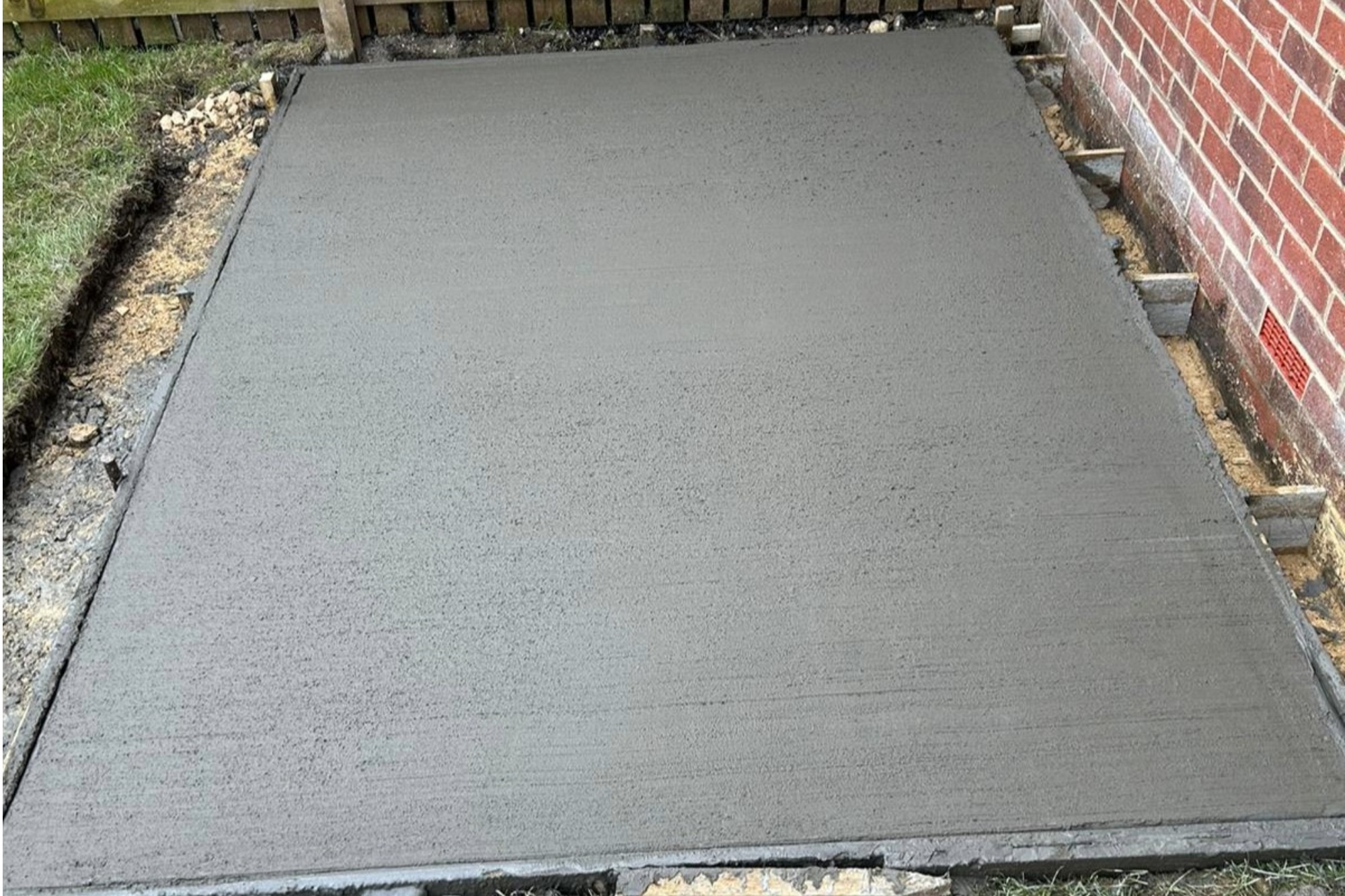
In the North East of England, concrete is the foundation for both functional and aesthetic landscaping. However, different projects demand different structural properties. Understanding the application helps in deciding whether to mix by hand or utilise a professional service.
- Driveways: These require high-strength mixes (typically C35 or C40) to withstand the point loading of vehicles and the freeze-thaw cycles of British winters.
- Patios: While less structurally demanding than driveways, patios require a creamy finish for aesthetic appeal and a level of durability that resists cracking under heavy garden furniture.
- Shed bases: A shed base must be perfectly level and thick enough to prevent heaving. Consistency across the entire slab is vital to ensure your garden building doesn’t lean over time.
- Pathways: These are often long and narrow, making them difficult to pour by hand without creating cold joints between batches.
- Fence posts: One of the few areas where hand-mixing or dry-pouring is often sufficient, as the concrete acts more as a stabiliser than a structural slab.
When mixing concrete on your own becomes a liability
While mixing concrete by hand is a valuable skill for minor repairs and small DIY tasks, larger projects present variables that manual mixing simply cannot control. Here is when you should transition to Titan Concrete’s professional supply services:
1. The one cubic metre rule
One cubic metre of concrete weighs approximately 2.4 tonnes. Attempting to mix this volume by hand leads to physical fatigue, which inevitably leads to sloppy ratios and poor-quality results.
2. Structural Integrity and cold joints
For large slabs like driveways or conservatory foundations, the concrete must be poured in a single, continuous wet session. If you mix by hand, the first batch will begin its initial set before the last batch is poured. This creates a cold joint, which is a structural seam that will inevitably crack and allow water ingress.
3. Precision grading
Certain projects require specific strength classes (e.g., C35 for heavy-duty traffic). Our volumetric mixers are computer-calibrated to deliver the exact strength required, removing the human error inherent in bucket-measuring.
The benefits of professional volumetric concrete delivery
For projects with variable requirements or uncertain measurements, volumetric concrete delivery is the most sophisticated solution available. Unlike traditional methods, volumetric trucks act as a mobile batching plant.
Because the concrete is mixed on-site, the tap can be turned off the moment your formwork is full. You only pay for what you use, down to the last litre. It also offers ultimate flexibility, for example, if you are pouring a shed base but then decide to use the remaining space for a small pathway, we can adjust the mix design or quantity instantly on-site.
Since the chemical reaction (hydration) doesn’t begin until the truck arrives at your property, you receive the freshest possible concrete with the maximum amount of time to spread and finish it. We can also deliver multiple mixes in one visit, recalibrating the machine in a single delivery for different requirements.
The benefits of professional ready mix concrete delivery
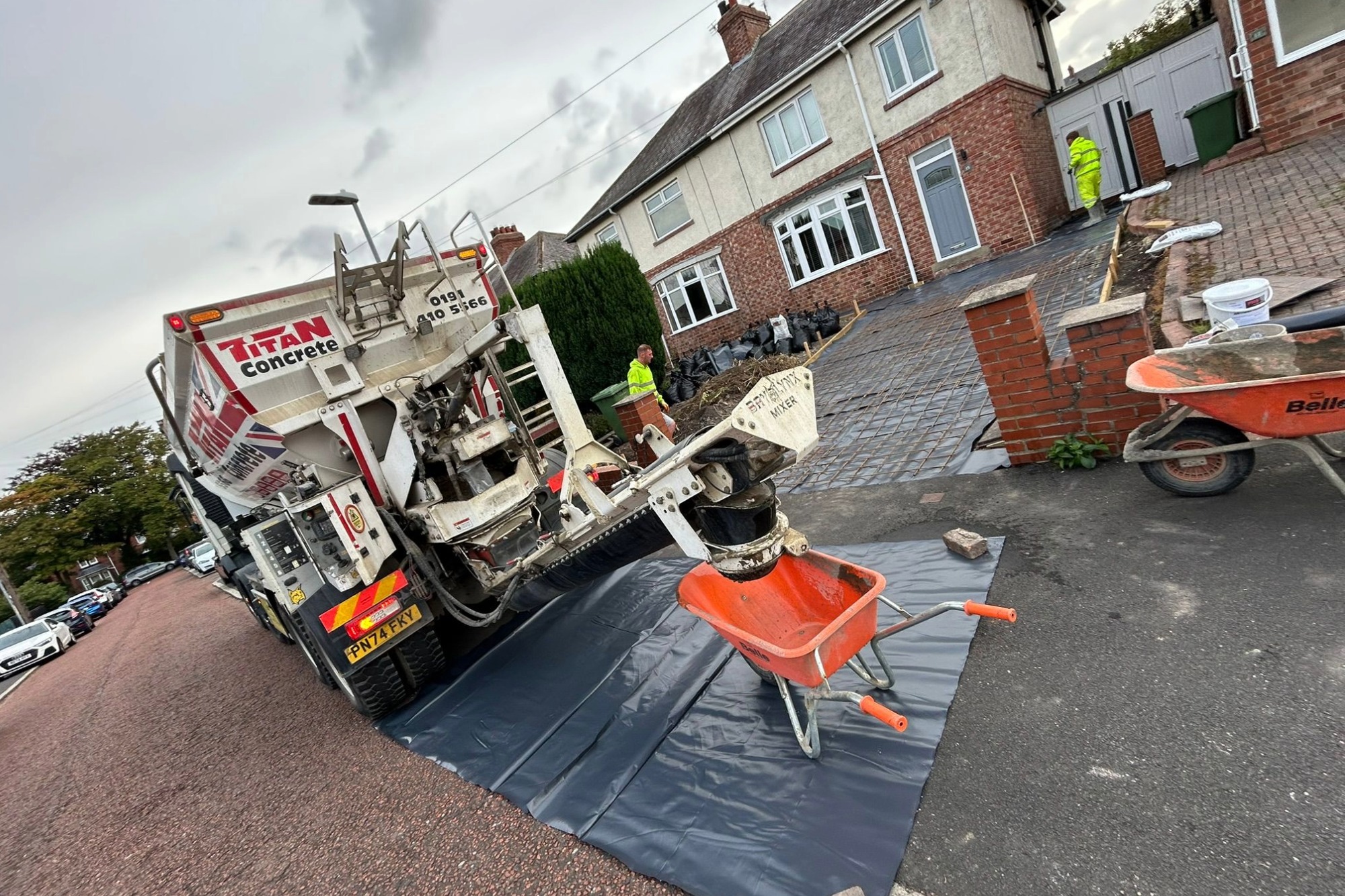
When speed, high volume, and guaranteed consistency are the primary drivers of your project, ready mix concrete is the industry gold standard.
Ready mix is precision batched at our central plant using highly sensitive electronic scales. This ensures that every cubic metre is identical in strength, colour, and aggregate distribution. If you are pouring a foundation for a house extension or a multi-car driveway, ready mix trucks can deliver large quantities (up to 8m³ or more) in a single pour, ensuring a seamless, monolithic slab. We also offer a concrete barrowing service so that we handle the heavy lifting of fetching and pouring.
The Titan advantage: professional grade, locally delivered
As a concrete authority in the North East, Titan Concrete bridges the gap between massive industrial pours and domestic precision.
Mixing concrete correctly is the difference between a project that lasts five years and one that lasts fifty. While we empower DIYers with the knowledge to handle small tasks, we stand ready to provide the heavy-duty support required for big garden renovations and significant structural work.
Use our Concrete Calculator to determine your requirements, or contact our expert team for professional advice across Newcastle, Gateshead, and the wider North East region.
Latest News


Friendly & efficient delivery service

Highest quality aggregates & concrete

Yard collection available on every product

Bespoke service tailored to your needs

Concrete Calculator
Knowing how much concrete you need is important when placing your order. Use our handy pre-mix concrete calculator to estimate the quantity of ready mixed concrete you require for your project.